
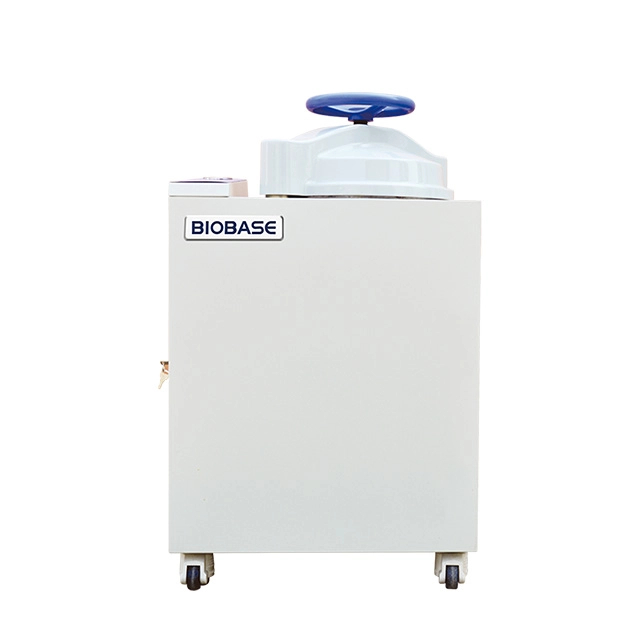
 Wide range of capacities
Vertical autoclaves
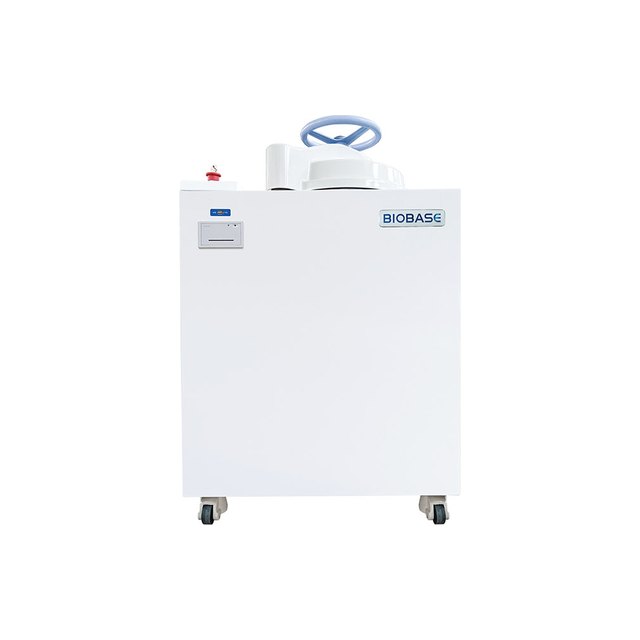
BIOBASE vertical autoclave · II series
BKQ-B50II · BKQ-B75II · BKQ-B100II · BKQ-B120II · BKQ-B150II · BKQ-B200II
- Capacity
- 50-200 L
- Temp.
- 105-136 and 50-134 °C depending on model
9 families of laboratory autoclaves from BIOBASE: vertical autoclaves, pulsed vacuum, and biosafety. Capacities from 30 to 200 L and working temperatures from 40 to 138 °C depending on the family. Models, electrical configuration and availability are confirmed in the quote.
9 product families
Wide range of capacities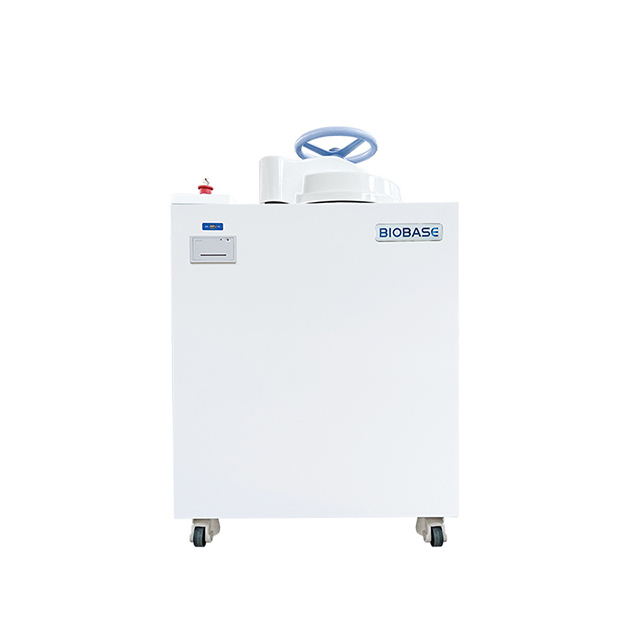 Built-in printer
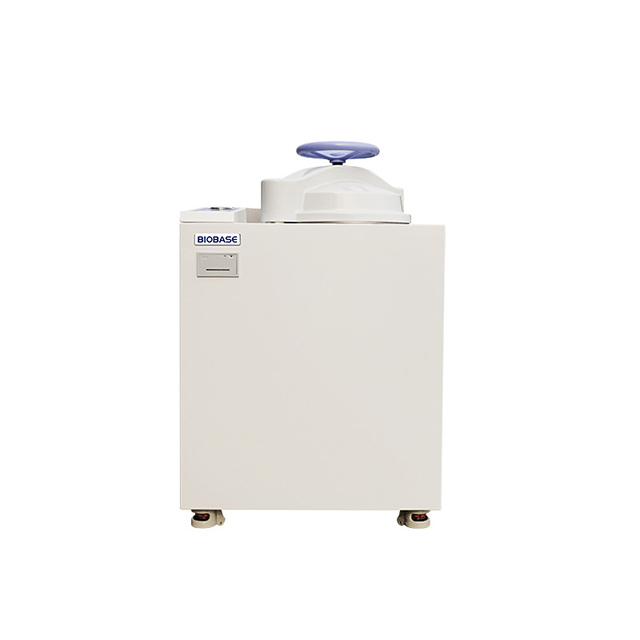 Vacuum system
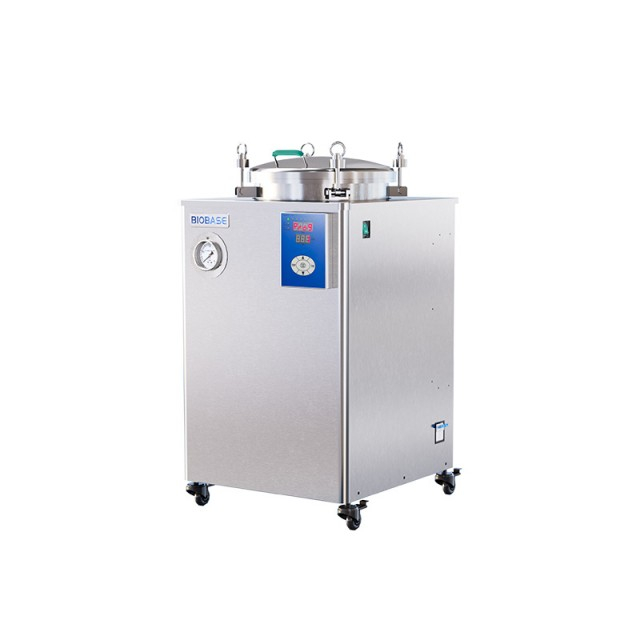 Compact format
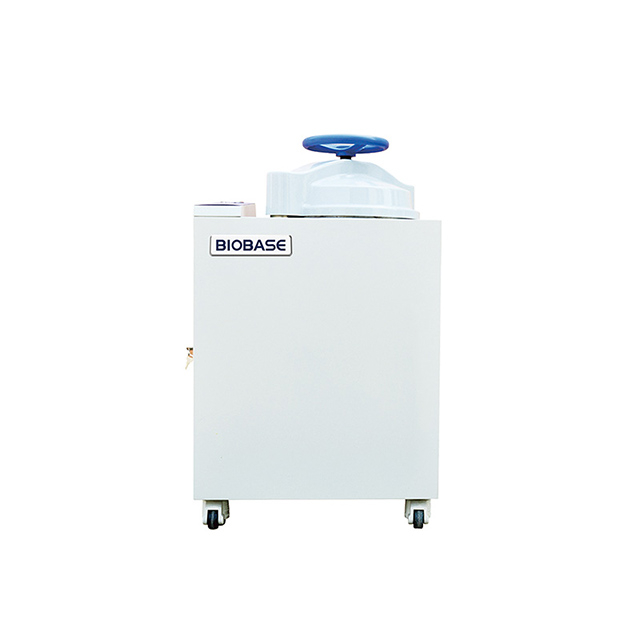 Configurable programs
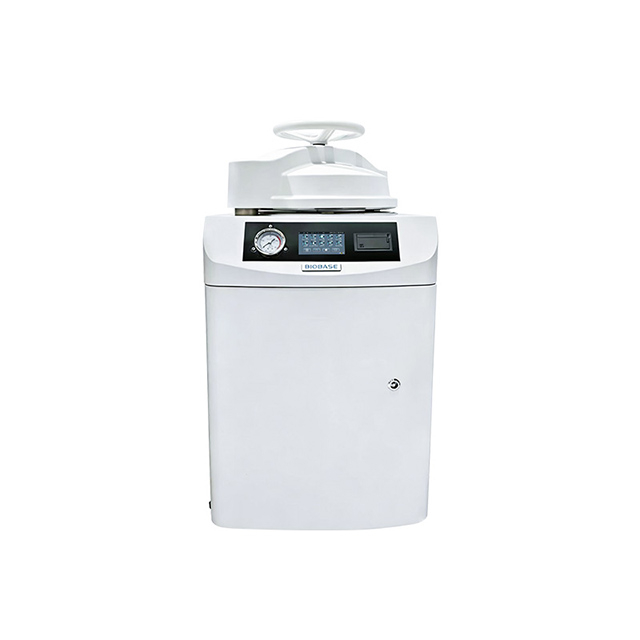 Movable sensor and USB
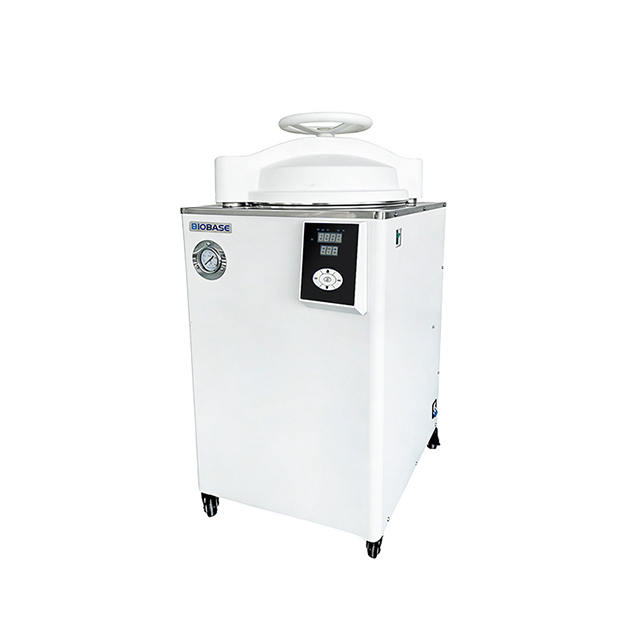 Simplified design
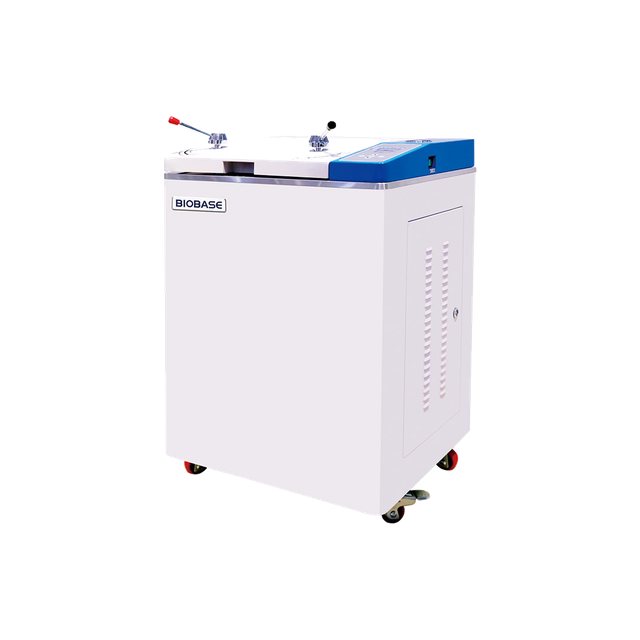 Tilting lid, quick opening
 Waste treatment
The decision is not capacity in liters. It is how the unit removes air from the chamber, because that is what determines what you can sterilize.
In a gravity autoclave, steam enters from the top and pushes the cold air toward the drain. It works with solid, exposed loads: glassware, loose instruments, media in open flasks. This is the principle behind eight of the nine families on this page.
Trapped air is the problem. In porous material —textiles, drapes, gauze, packaging material— and in hollow material —pipettes, tubing, narrow-neck flasks— the air becomes occluded and the steam front stops there. The inner surface is not sterilized, and nothing in the cycle record reveals it: the probe measures the chamber, not the inside of the item. Those loads need pulsed vacuum, which evacuates the chamber in pulses before exposure. In this catalog, a single family does that.
What changes is the exhaust phase. When the cycle ends, the liquid is above its boiling point at atmospheric pressure: if pressure falls faster than the liquid cools, it boils over, spills and can break the vessel. That is why the exhaust is slow and controlled, and why it is worth confirming whether the unit measures the temperature of the liquid with a flexible probe or only that of the chamber.
From the liters of the chamber you have to subtract the water at the bottom on units that generate their own steam, the volume of the basket, and the space the steam needs in order to circulate. The working rule is not to go beyond 75-80% of the chamber. The useful question is not how many liters, but how many flasks or how many bags per cycle, and how many cycles per shift.
The power supply available —several families draw more than 4 kW—, the drain point, and the source of distilled or demineralized water. Mains water carries chlorides, which pit the stainless steel of the chamber, and calcium carbonate, which scales, insulates thermally and ends up flaking off onto the load.
In Chile, every autoclave working at 0.5 kg/cm² or above must be entered in a registry of the SEREMI de Salud —the regional health authority— before it goes into operation. Every unit on this page falls within that scope. The paperwork is the owner's, but three of the supporting documents can only be issued by the manufacturer, and the hydraulic test certificate is issued at the end of manufacturing: it cannot be obtained later. It is worth settling at the time of purchase and not at the time of installation.
View the full catalog · View refrigerators · View stirrers and shakers · View pipetting and dispensing · View balances · View heating equipment · View ultrasonic cleaning · View spectrophotometers · View vacuum pumps · View infrared sterilizers
Describe the equipment you are looking for and we will prepare a quote, whether or not it appears in our catalog.