
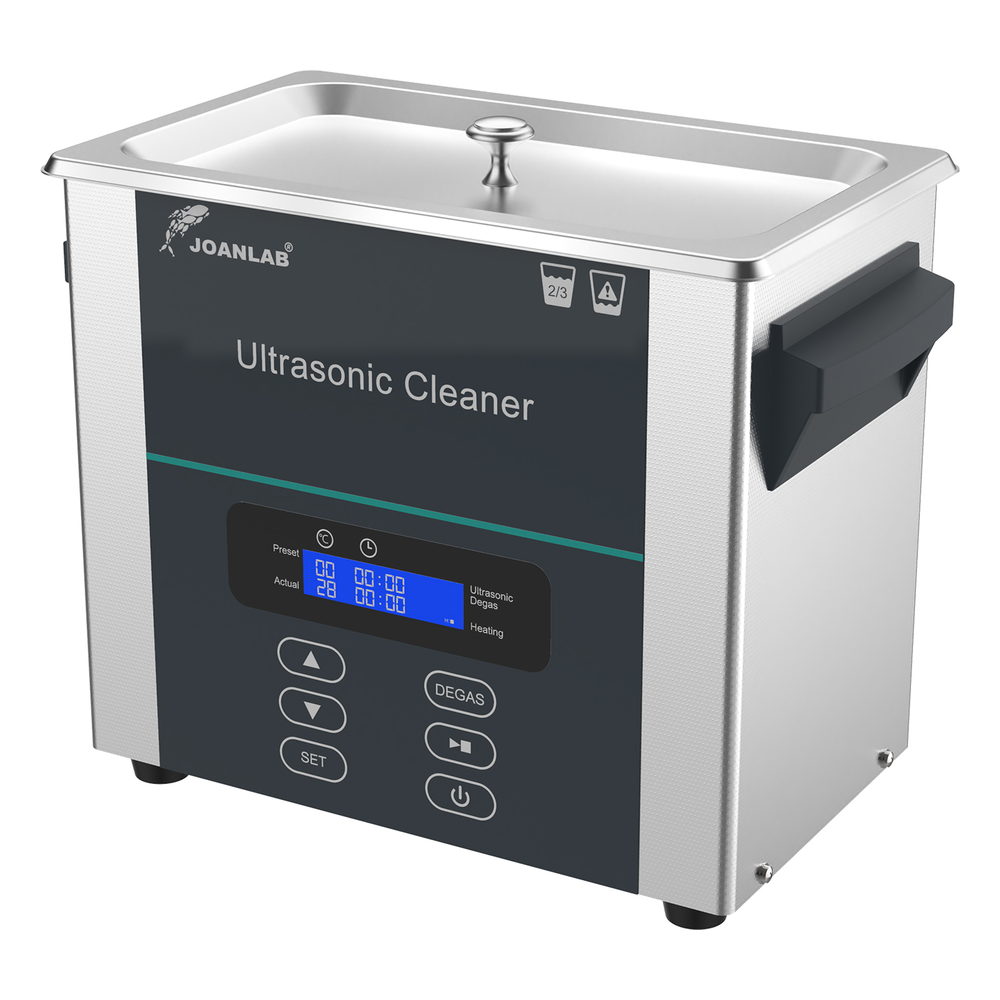
 With heating and degassing
Ultrasonic cleaners
JOANLAB ultrasonic cleaner · UC series
UC20D · UC30D · UC60D · UC100D · UC150D · UC200D · UC300D
- Capacity
- 2-28 L
- Frequency
- 40 kHz
1 family of laboratory ultrasonic cleaning from JOANLAB: ultrasonic cleaners. Models, configuration and availability are confirmed in the quote.
1 product family
With heating and degassingThe unit vibrates the liquid at ultrasonic frequency. On each low-pressure half cycle microscopic bubbles form and collapse on the next one, and next to a solid surface that collapse is asymmetric: it drives a microjet against the part. That impact lifts particles and films of dirt away.
Only what is wet gets cleaned: whatever stands above the level of the liquid, or the cavity where air stayed trapped, receives nothing. Parts also shadow one another, so piled up they clean worse than spread over two runs. In exchange, ultrasound reaches where a brush does not: threads, grooves, narrow bores, narrow-neck glassware.
Frequency sets the size of the bubbles and the energy of each collapse: lower gives large bubbles and hard blows, good against baked-on dirt and harsh on delicate surfaces; higher gives small bubbles and a gentle action, better on fine detail.
The seven models on this page declare the same working frequency, 40 kHz. Here frequency is not a variable you get to choose: if your procedure calls for another one, that requirement has to be raised before requesting a quote.
A freshly made solution carries dissolved air. That gas gets into the bubbles and cushions the collapse: the first minutes with new liquid clean badly, and the usual mistake is to conclude that the unit does not perform. Degassing serves to drive that air out before loading the tank, and the datasheet on this page declares it.
Temperature drives the chemistry of the detergent, but more is not always better: as it approaches boiling, vapor pressure rises, the bubbles fill with vapor instead of imploding and cavitation weakens. Time is not free either: the same microjet that lifts the dirt erodes soft metals if the exposure is drawn out.
The solution saturates and has to be renewed, and how the tank is emptied is part of the choice. The datasheet declares a drain valve from the 6 L model onward; below that capacity it does not declare one.
Flammable solvents, never directly: acetone, ethanol, isopropyl alcohol. The accepted procedure is indirect, with water in the tank and the solvent in a glass beaker partly submerged, which the ultrasound passes through. Chlorine is out too: the chloride ion keeps the passive layer of the stainless steel —the declared tank material— from re-forming, and a pitted tank ends up leaking.
Parts do not rest on the bottom either: the contact point goes uncleaned and that is where wear concentrates. They go in a basket or suspended, and the datasheet does not declare a basket: it is worth asking.
The three measurements of the largest part and how many go in per run: that figure picks the model better than liters do, because the part has to end up covered and with space around it.
The material of the parts and what dirt has to come off, because the cleaning solution and how often it has to be renewed depend on that. Also the bench space, the nearest drain point and the electrical supply where it will be installed.
View the full catalog · View autoclaves · View refrigerators · View stirrers and shakers · View pipetting and dispensing · View balances · View heating equipment · View spectrophotometers · View vacuum pumps · View infrared sterilizers
Describe the equipment you are looking for and we will prepare a quote, whether or not it appears in our catalog.