
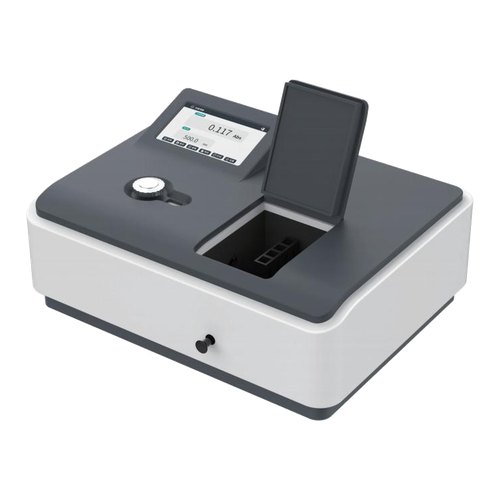
 7-inch touchscreen
Visible spectrophotometers
JOANLAB visible spectrophotometer · V-Pro series
V300Pro · V500Pro · V600Pro
- Range
- 320-1100 nm
- Bandwidth
- 2 and 4 nm
2 families of laboratory spectrophotometers from JOANLAB: visible spectrophotometers and uV/visible spectrophotometers. Models, configuration and availability are confirmed in the quote.
2 product families
7-inch touchscreen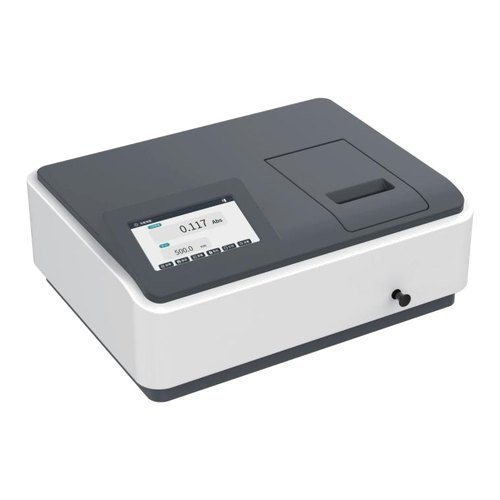 From 190 nm, automatic switchover
A spectrophotometer does not measure concentration: it measures how much light reaches the detector with the sample in place and how much reached it without. A diffraction grating opens white light into its spectrum, the monochromator lets only a narrow portion through, that portion crosses the cuvette and the detector compares. Absorbance is the logarithm of that ratio; only a calibration curve turns it into concentration.
Three factors weigh in that conversion: how much the substance absorbs at the chosen wavelength, how much of it there is, and how much path the light travels inside the liquid. The path is set by the cuvette holder, and the two families on this page declare it manual and 1 cm; neither declares another. It is worth confirming which cuvettes it takes and how many.
The two families are not separated by tier but by the spectral range they declare. The visible family starts at 340 nm on the V300Pro and at 320 nm on the V500Pro and the V600Pro; no model goes lower. Whatever absorbs below the floor of the model you choose falls outside its reach, and no adjustment corrects that: it is the limit of the declared range. Between 320 and 340 nm only the V500Pro and the V600Pro read.
Many determinations reveal the analyte with a reagent that forms a colored compound and read it in the middle of the visible; iron with o-phenanthroline is solved that way. Others read the substance as it is, with no color development, and those tend to fall in the ultraviolet, like nitrate in water. The UV/visible subcategory is there for that second case.
The monochromator does not deliver a single wavelength but a band of a certain width, and the detector receives everything that falls inside it at once: the reported absorbance is the logarithm of an averaged transmittance. If the peak of the analyte is narrower than that band, the maximum flattens, the reading comes out below the real value and the calibration stops being straight at its upper end.
That is why bandwidth is judged against the peak and not in the abstract: the broad bands of colored complexes tolerate a coarser instrument; the narrow peaks of the ultraviolet do not. The catalog declares it model by model.
The light source is the component that ages: as it loses intensity the noise of the reading rises and the baseline gets harder to stabilize, until it has to be replaced. The catalog does not declare which lamp any of these units carries, how long it lasts, or the part number the replacement is ordered under: it leaves that to be confirmed. It is worth settling before closing the purchase: with no replacement identified, the unit stops the day the lamp is done.
The method you are going to follow and the wavelength it reads at: that figure settles the family and narrows down the bandwidth.
The type of cuvette and the sample volume you have available. The catalog declares the cuvette holder, not the cuvettes nor which ones come with it. Ordinary glass and plastic do not transmit in the ultraviolet, so a method that reads there calls for quartz.
And what the table leaves open: the lamp and its replacement, the dimensions and the weight, the language of the interface —in the catalog renders the labels are in Chinese— and the data output: there is a touchscreen and a USB port, and PC software and Bluetooth printing are listed as optional.
View the full catalog · View autoclaves · View refrigerators · View stirrers and shakers · View pipetting and dispensing · View balances · View heating equipment · View ultrasonic cleaning · View vacuum pumps · View infrared sterilizers
Describe the equipment you are looking for and we will prepare a quote, whether or not it appears in our catalog.